No cloud or JBA.AI data sharing. Your projects stay secure and compliant with GDPR & HIPAA.
Full functionality anytime, anywhere. Works seamlessly without internet. No cloud storage costs, no interruptions.
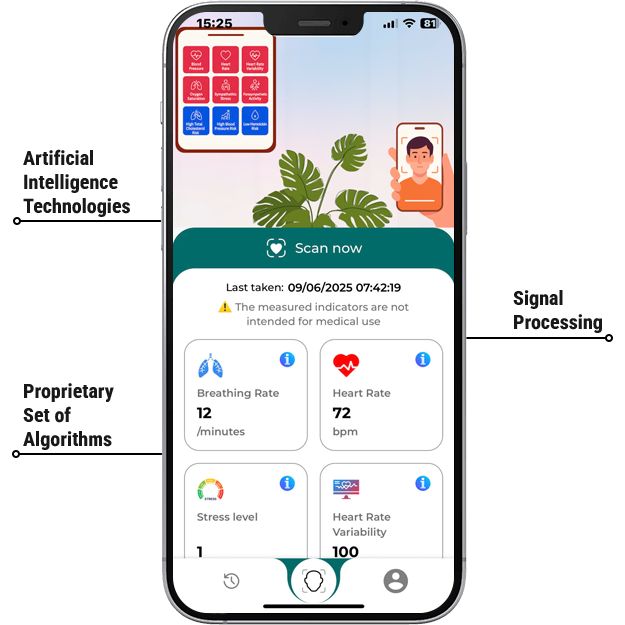
JBAAI’s software-based technology utilizes advanced AI and deep learning algorithms to extract key health measurements using Photoplethysmography (rPPG) within 20-60 seconds. By combining computer vision, signal processing, and machine learning techniques, JBAAI analyzes rPPG signals to deliver vital signs and biomarker measurements with high accuracy.
Delivered as a Software as Medical Device (SaMD) App (JBAAI App), the technology supports:
📱 Contactless- based rPPG spot checks via camera-based devices such as smartphones and tablets
⏱️ Continuous monitoring through contact-based rPPG sensors for real-time health tracking
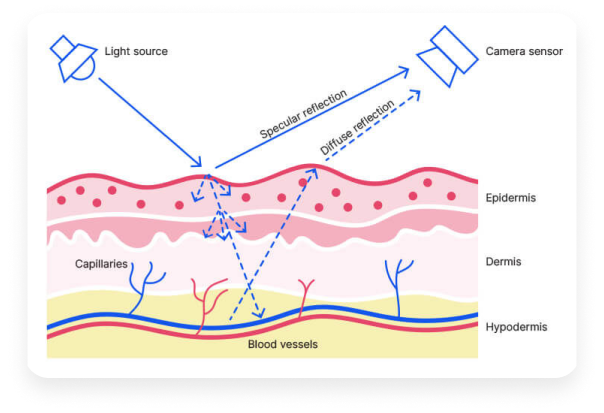
Photoplethysmography (PPG) is a proven, non-invasive optical method for tracking physiological signals. First introduced in hospital oximeters in 1942, it is now widely embedded in wearable devices to monitor metrics like heart rate and dynamic changes in blood volume. The technique works by shining light into the skin and measuring the amount reflected or transmitted as blood pulses through the tissue. By analyzing these pulsatile light-absorption variations, PPG provides accurate insight into cardiovascular function and other vital signs.
JBAAI offers flexible facial scanning solutions, whether for immediate evaluations
or multiple measurements throughout the day.
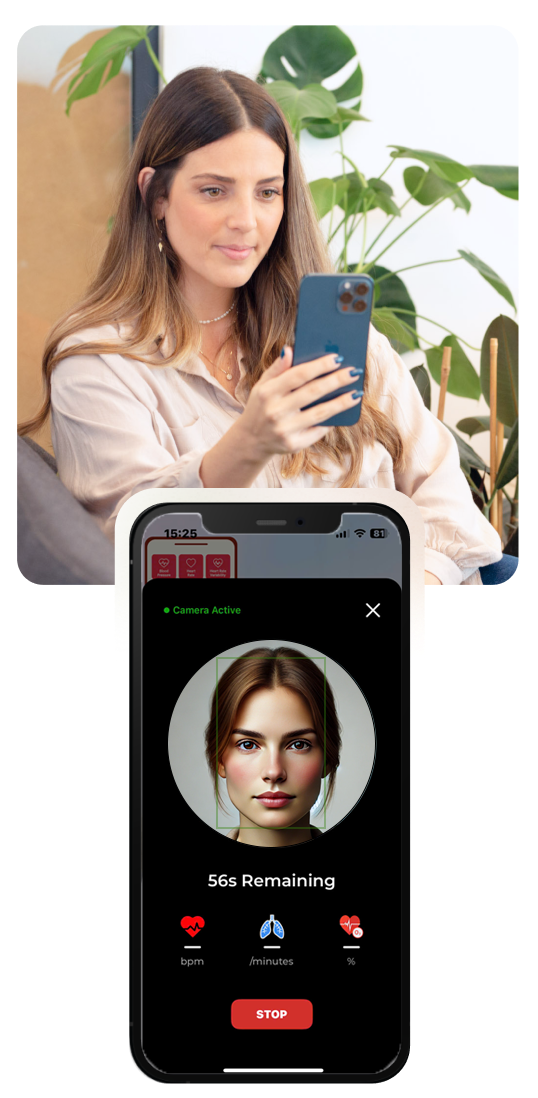
The end user takes a 35-60 second video selfie while at rest
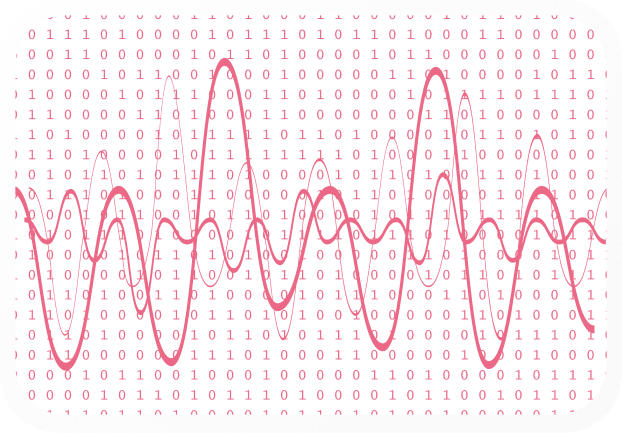
JBAAI generates a PPG signal remotely using video input
The PPG signal is processed to eliminate noise and optimize the signal-to-noise ratio (SNR)
The processed signal is fed into JBAAI’s unique combinations of models and proprietary set of algorithms to process each vital sign or biomarker
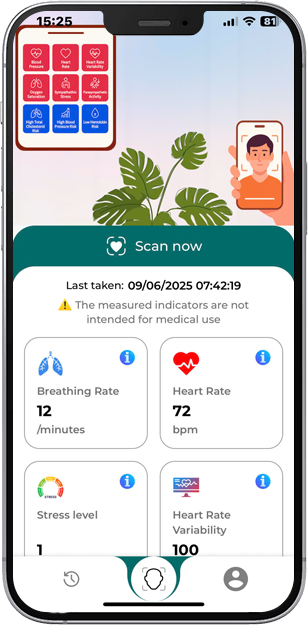
The final results are displayed on end user’s device. JBAAI has no access to the data or results
The JBA AICare Ring is a next-generation Micro-Hub Health Ring (Patent Pending) designed to collect physiological data safely and continuously. The ring performs no on-device analysis and no medical interpretation. All advanced insights are processed externally through the FDA-listed JBA AI Software as a Medical Device (SaMD).
The ring itself is not a diagnostic medical device. It is a data-collection hardware module.
The JBA AI SaMD is the FDA-registered component (Product Code: PWC, Class I).
No.
The AICare Ring belongs to a new category:
👉 Micro-Hub Health Ring — a device that captures raw physiological signals while all AI processing happens outside the ring.
Pure data acquisition (no scores calculated on the ring)
External AI interpretation via FDA-listed SaMD
Multi-modal fusion (ring biosignals + FaceScan)
Titanium Grade 5 medical-device construction
Ultra-light comfort for 24/7 wear
Privacy-first, encrypted data pipeline
JBAAI offers a software-only Health Data Platform that enables spot and continuous health and wellness checks anytime, anywhere, utilizing cameras on smartphones, tablets.
Heart rate (PPG)
HRV (calculated externally by SaMD)
Peripheral circulation trends
Sleep movement patterns
Daily activity steps & calories
Training metrics (distance, steps, calories)
All interpretation occurs outside the device.
Yes. It is engineered for continuous wear with:
Lightweight Titanium Grade 5
5ATM water resistance
Sweat-proof surface
Comfortable ergonomic fit
Optimized battery performance
Automatic, secure data sync
Ideal for sleep, workouts, and everyday life.
The ring collects raw PPG signals.
The JBA AI SaMD analyzes circulation patterns, stress trends, and physiological rhythms, but not medical-grade BP/SpO₂ readings.
It is designed for wellness insights, not clinical diagnosis.
Yes. The ring stores data locally and automatically syncs when Bluetooth reconnects.
Daily circulation trend score
Stress pattern mapping
Heart rhythm variability analysis
Sleep movement insights
Activity & recovery patterns
Abnormality detection (non-diagnostic)
Monthly AI health summaries
AI voice alerts for significant deviations
Neuro-AI Sleep Entrainment (2026)
Mastermind Focus AI (2026)
Angel Guardian Early-Signal Engine (2026)
GLP-1 Metabolic Trend Score (2025–2026)
Liver Stress Risk Score™ (2025 Q4)
Circulation Mapping AI (2025 Q3)
Comprehensive Monthly AI Reports
Voice-activated abnormality alerts
All computations are done externally, not on the ring.
No.
The ring performs no scoring, no interpretation, and no adaptive sensing.
All intelligence comes from the JBA AI SaMD ecosystem.
Encrypted Bluetooth transmission
Secure AES-encrypted cloud storage
Data hosted in the United States
No third-party selling or sharing
User-controlled permissions
No microphone access.
Camera access is only used when you intentionally perform FaceScan to assist AI circulation analysis.
Titanium Grade 5 (Ti-6Al-4V) is a medical-device-grade titanium alloy used in:
Surgical implants
Orthopedic screws
Dental posts
Aerospace structures
High-strength medical tools
It combines extreme strength, light weight, biocompatibility, and corrosion resistance—ideal for a 24/7 wearable.
4–5× stronger than Grade 1 or Grade 2 titanium
40% lighter than stainless steel
Hypoallergenic (no irritation)
Does not deform under heavy use
Resistant to sweat, saltwater, and chlorine
Premium longevity and scratch resistance
Stable housing for precision sensor alignment
Much lighter
Far more corrosion-resistant
More durable under pressure
Does not cause skin reactions
Retains finish significantly longer
Stainless steel is common in jewelry; Titanium Grade 5 is used in medical implants.
Most consumer wearables use stainless steel, coated alloys, or lower-grade titanium.
Titanium Grade 5 provides:
Medical-device-grade biocompatibility
Superior structural strength
Lightweight comfort for 24/7 wear
Corrosion-proof performance
Greater long-term durability
Better structural stability for sensor alignment
This alloy belongs to a higher-grade material class—closer to surgical implants than standard consumer accessories.
No.
The ring is a wellness-focused micro data hub.
The JBA AI SaMD provides trend-based wellness insights, not medical diagnosis.
Yes.
JBA AI will support Telehealth Sharing Mode (2026), allowing users to securely share their AI-interpreted wellness trends with healthcare professionals.
No.
All upgrades happen through SaMD cloud updates, not hardware.
Options include:
JBA AI Basic (included)
JBA AI Premium (advanced AI insights)
Neuro-AI Modules (2026 add-ons)
Taking a health check with JBAAI’s technology is effortless, even for those without technical expertise. It’s as simple as taking a 35-60 second video selfie! For optimal results, users should remain still, avoid talking, and ensure they are in a well-lit environment. JBAAI’s technology is designed to measure health indicators while the user is at rest.
Delivered as a Software as Medical Device (SaMD) App (JBAAI App)
JBAAI’s video-based spot-check technology is delivered as a ready-to-use app.
JBAAI’s continuous check technology is delivered as a ready-to-use app.
Continuous monitoring through contact-based PPG sensors for real-time health tracking
JBAAI is compatible with a range of devices and platforms, including iOS and Android mobile devices.
JBAAI’s continuous checks are compatible with the Polar Verity Sense™.
No, JBAAI does not have access to end-user data.
JBAAI’s unique edge architecture allows end users to perform health checks without an internet connection.
JBAAI’s fall detection technology uses the gyroscope and accelerometer of the JBA AICare™ Band and Ring, worn by the user, to detect falls. In the event of a fall, the system can generate a timed notification prompting the user to respond. If unanswered, the system triggers two consecutive vital signs checks while an alert with the location of the event can be sent to designated contacts.
JBAAI operates on a B2B and B2C model and does sell directly to consumers.
Sign in to your account